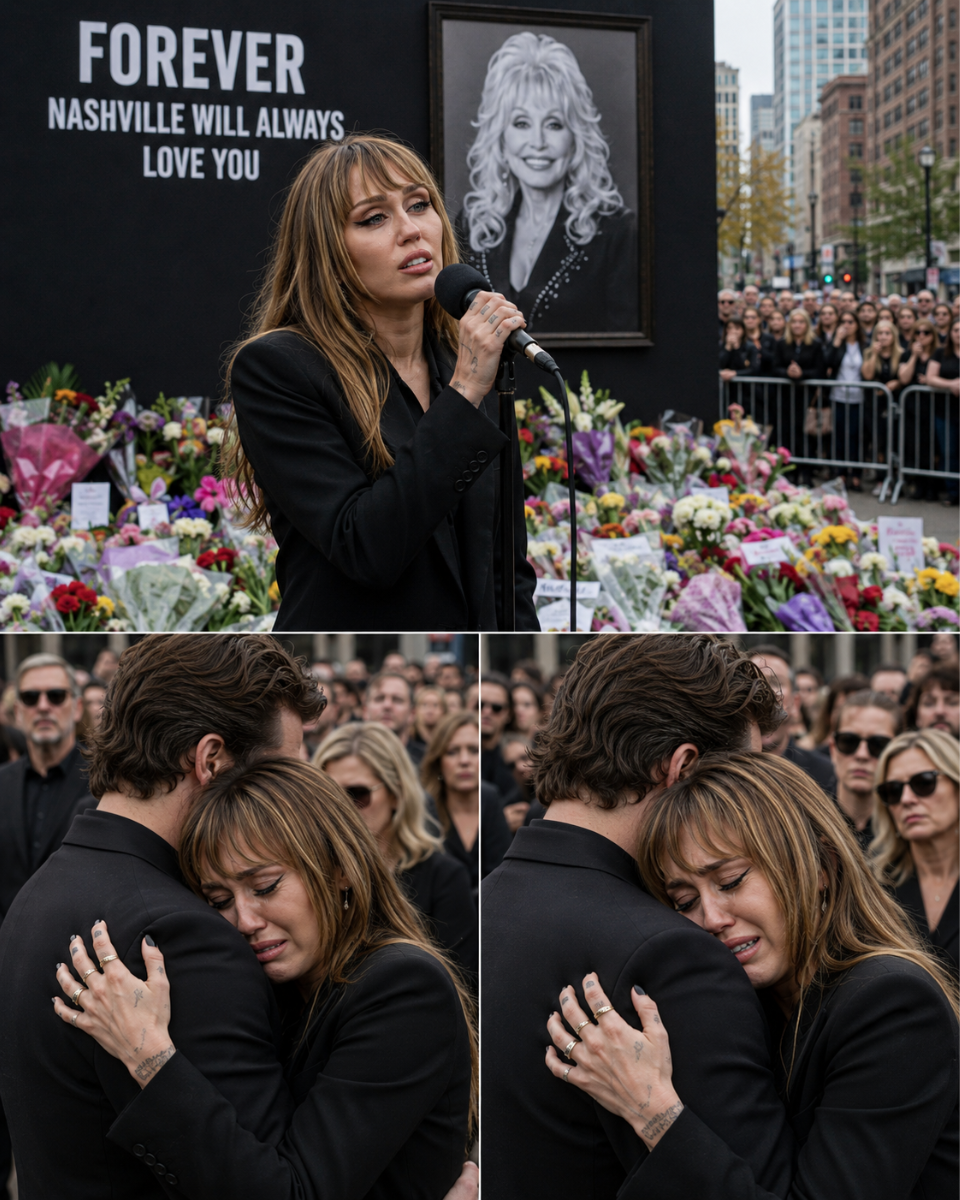
Then comes the moment at the center of the story, an imagined final request so emotionally overwhelming that countless fans immediately understand why the scene has generated such intense discussion across social media.
Dolly, according to this fictionalized tribute scenario, had wanted Miley to sing as part of her farewell, transforming one of their most familiar musical connections into something almost unbearably personal for the goddaughter left behind.
Miley reportedly takes a breath in the retelling, steadies herself before the grieving congregation, and begins singing “Jolene,” the legendary song that became inseparable from Dolly’s musical idenтιтy across more than half a century.
Her voice is imagined cracking almost immediately, but instead of destroying the performance, that imperfection becomes its emotional center, revealing a grieving goddaughter attempting to continue singing while memories seemingly overwhelm every carefully controlled breath.
Nobody inside the imagined ceremony needs technical perfection, because this is not presented as an awards show performance where vocal precision will be dissected afterward by critics, producers, commentators, and millions of strangers online.
What matters is the vulnerability of continuing when stopping would be understandable, allowing every note to carry something no polished studio recording could reproduce: the painful realization that some performances can never receive an encore.
The narrative describes family members lowering their heads while others openly cry, as the familiar melody suddenly takes on a different meaning when separated from bright stages and placed inside the solemn atmosphere of remembrance.
Outside, the imagined grief spreads through Nashville, where fans gather carrying flowers, pH๏τographs, handwritten messages, and memories connected to songs that accompanied weddings, childhoods, heartbreaks, road trips, family gatherings, and deeply private moments.
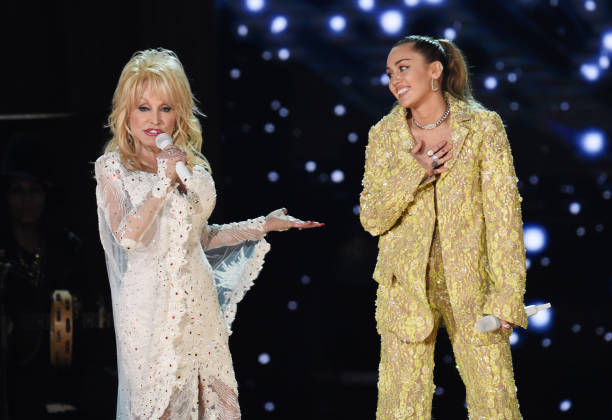
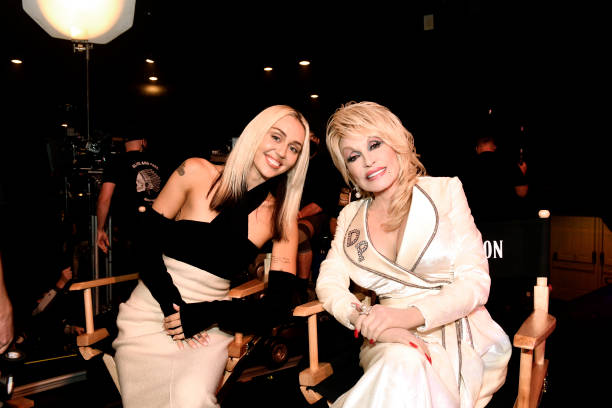
For many admirers, however, the emotional power comes from something larger than the ceremony itself, because Miley and Dolly represented an unusual relationship between two women from dramatically different generations of popular music.
Dolly never appeared interested in forcing Miley to become a younger version of herself, while Miley repeatedly showed affection and admiration for the woman whose enormous legacy could easily have overshadowed anyone standing beside her.
That relationship is why the imagined scene has triggered such pᴀssionate responses, with fans debating which song would truly represent their connection and whether “Jolene” would be heartbreaking, celebratory, or almost too emotionally difficult.
Some argue that another Dolly classic would better represent a final farewell, while others believe “Jolene” carries precisely the recognizable musical history necessary to make an entire congregation understand what has suddenly been lost.

The disagreement itself demonstrates something remarkable about Dolly’s catalog, because different generations can choose completely different songs as their defining memory while still feeling equally certain that their selection captures something essential about her.
There is also another question underneath the emotional reactions: should intensely private moments of grief involving famous families ever become public spectacles, even when millions of admirers understandably feel personally connected with the artist being remembered?
Some fans believe public tributes allow people who never met their heroes to participate in collective mourning, while critics argue that celebrity culture too often turns grief into shareable content before families have space to process it.
That tension would make a moment involving Miley especially complicated, because cameras have followed enormous portions of her life since childhood, transforming milestones, controversies, relationships, reinventions, successes, and painful experiences into public conversation.

Yet an imagined farewell to Dolly feels fundamentally different from those familiar celebrity narratives, because the emotional center is not scandal, career strategy, rivalry, or attention, but the devastating simplicity of saying goodbye to family.
Perhaps that is why the image of Miley struggling through a familiar Dolly song feels so powerful even as a tribute narrative rather than a verified account of an actual funeral ceremony.
It invites audiences to imagine what happens when a performer accustomed to commanding enormous arenas suddenly discovers that the hardest audience to sing before is a quiet room filled with people who understand exactly why she is crying.
Every cracked note would become part of the farewell, every pause would carry history, and every lyric would remind listeners that music survives moments its creators and performers eventually cannot.
By the final imagined lines, nobody is described as caring whether Miley sounds flawless, because grief has transformed the performance from entertainment into testimony about mentorship, family, memory, and the strange permanence songs achieve after people disappear.
The last note eventually fades, but the silence afterward becomes almost louder than the music, leaving the congregation suspended between applause and mourning as Miley reportedly stands motionless, struggling to regain her composure.
In that imagined silence exists the reason this story continues touching people: almost everyone understands the unbearable desire to say one more thing, hear one more laugh, or somehow postpone one final goodbye.
For Miley, Dolly’s influence can be remembered through performances, interviews, pH๏τographs, conversations, and the unmistakable affection they publicly displayed, creating a relationship fans often viewed as refreshingly genuine within an industry built around carefully managed appearances.
For audiences, their connection also offered something increasingly rare, showing how two fiercely individual women could belong to different generations without turning those differences into compeтιтion, resentment, or manufactured rivalry.
And that may ultimately be the most powerful idea behind this emotional tribute scenario, because the imagined final song is not really about death, celebrity, Nashville, or even one unforgettable composition.
It is about what remains when the spotlight finally disappears: the people who believed in us, the memories we carry forward, and the love powerful enough to make even the strongest voice tremble.