
More than 60 witnesses have reportedly been interviewed.
The FBI is ᴀssisting with digital evidence.
Two autopsies have been conducted.
Videos, pH๏τographs, GPS records, witness accounts, phone information, and boat movements have all been examined.
And yet one crucial stretch of time in the death of Nolan Xavier Wells remains unresolved.
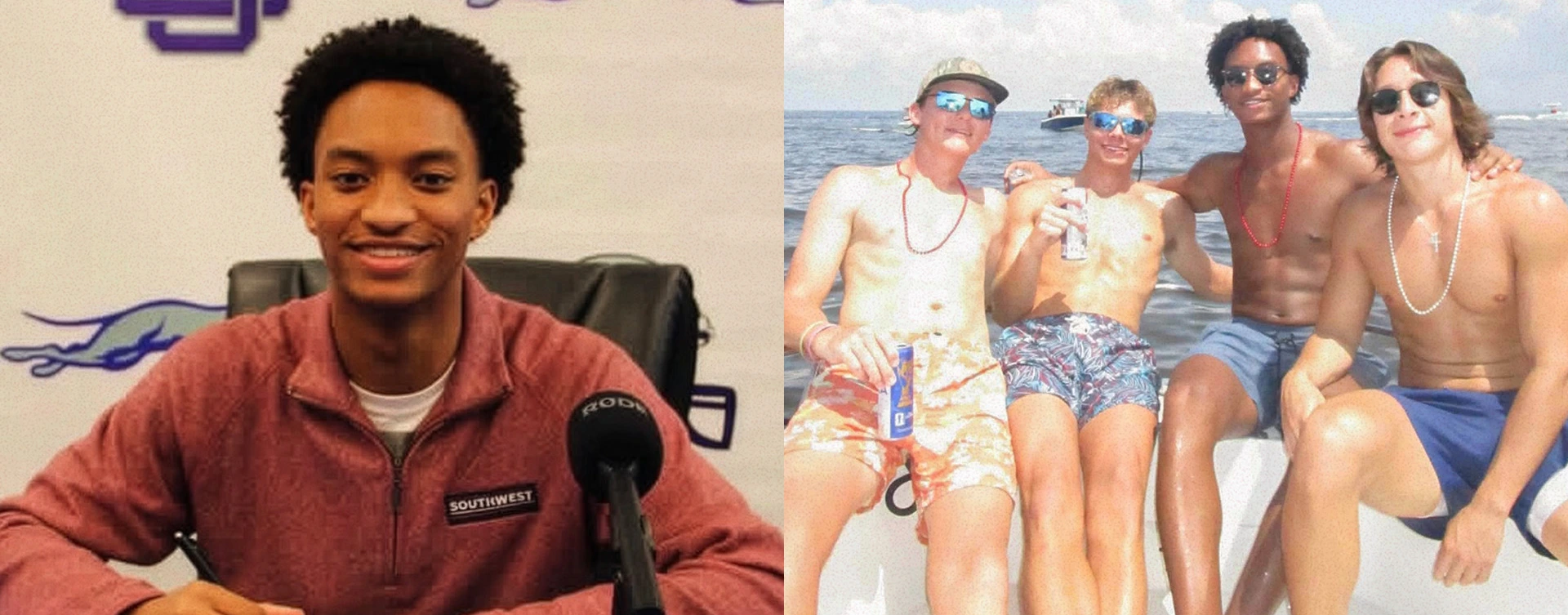
On July 4, 2026, at approximately 2:23 in the afternoon, an image captured the 18-year-old Mississippi college student alive on Horn Island.
Two days later, a National Park Service ranger found his body along the island shoreline.
Between those two moments sits a gap that weeks of investigation have not completely closed.
That does not mean a crime has been proven.
According to the material provided, authorities said in early August that they did not suspect foul play.
No person has been charged in connection with Nolan’s death.
Neither of the two autopsies discussed in the source established exactly how he died.
But the absence of a proven crime does not erase the unresolved questions.
For Nolan’s family, those questions begin with the timeline.
Nolan Wells was from Ocean Springs, Mississippi.
He had graduated from Ocean Springs High School in 2025 and played wide receiver at Southwest Mississippi Community College.
He was only 18.
He would have turned 19 in August.
On July 3, he reportedly told his parents that he planned to spend the holiday weekend with friends.
The following morning, the trip began.
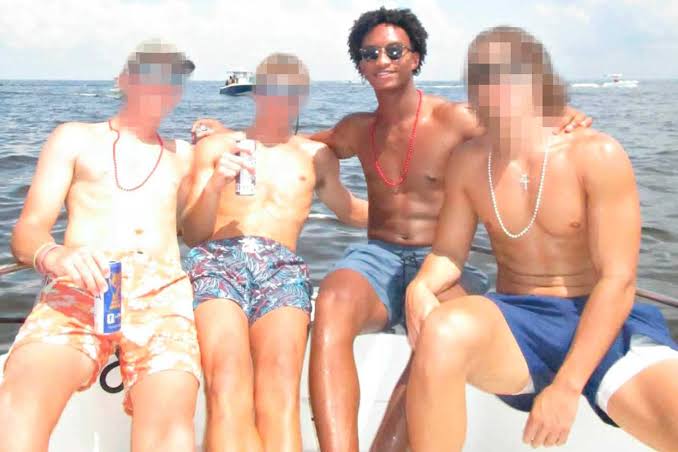
According to GPS records described in the source, the boat left the Mississippi mainland at approximately 9:56 in the morning.
At 11:14, it arrived at Horn Island, a protected barrier island roughly 10 miles offshore.
The island was crowded that day.
Approximately 300 people were reportedly there celebrating Independence Day.
At 2:23 in the afternoon, the final known image of Nolan was recorded.
That timestamp has become one of the most important fixed points in the case.
It is not based on someone’s later memory.
It is part of the documented record.
Then the timeline becomes more complicated.
Around 4 in the afternoon, someone on the boat called Sea Tow because the vessel was taking on water.
During that call, according to the source, the caller indicated there were approximately seven people aboard.
When asked whether everyone was safe, the caller reportedly said everyone was on board.
That statement immediately becomes significant because Nolan was not on the boat when it later returned to the mainland.
At approximately 4:31 in the afternoon, the boat left Horn Island.
At 5:52, it reached Fort Bayou.
At 6:06, it docked.
By approximately 7:19, the boat was reportedly out of the water and being transported toward the owner’s home in Biloxi.
Nolan was not with it.
According to the account given to investigators, Nolan had chosen to remain on Horn Island with a young woman and planned to return later with another group.
That young woman is real.
She has reportedly been identified and is cooperating with investigators.
That matters because one of the most persistent online accusations was that the woman had been invented to support the friends’ account.
According to the source, investigators have confirmed that she exists.
But Nolan’s family still struggles with the idea that he voluntarily separated from the people he arrived with.
They reportedly believe he would not have stayed behind without his phone.
That phone creates another layer of uncertainty.
Later that evening, Nolan’s parents used a tracking application and located the phone at a friend’s house on the mainland.
His car keys were also reportedly with a friend.
His vehicle was somewhere else.
For the family, those details were difficult to reconcile with the explanation that Nolan simply remained on the island by choice.
Why would he stay without his phone.
Why were his keys elsewhere.
What did he intend to use to communicate.
And what happened after the last confirmed image of him.
At approximately 11 that night, one of the young men from the trip contacted Nolan’s parents.
Nolan was reported missing.
The search began the following morning.
The Jackson County Sheriff’s Office joined the operation.
The United States Coast Guard became involved.
The Mississippi Department of Marine Resources participated.
The National Park Service participated.
The United Cajun Navy ᴀssisted.
Aircraft and boats searched the surrounding area.
For more than 40 hours, crews tried to locate Nolan.
On the morning of July 6, a National Park Service ranger found his body along the shoreline.
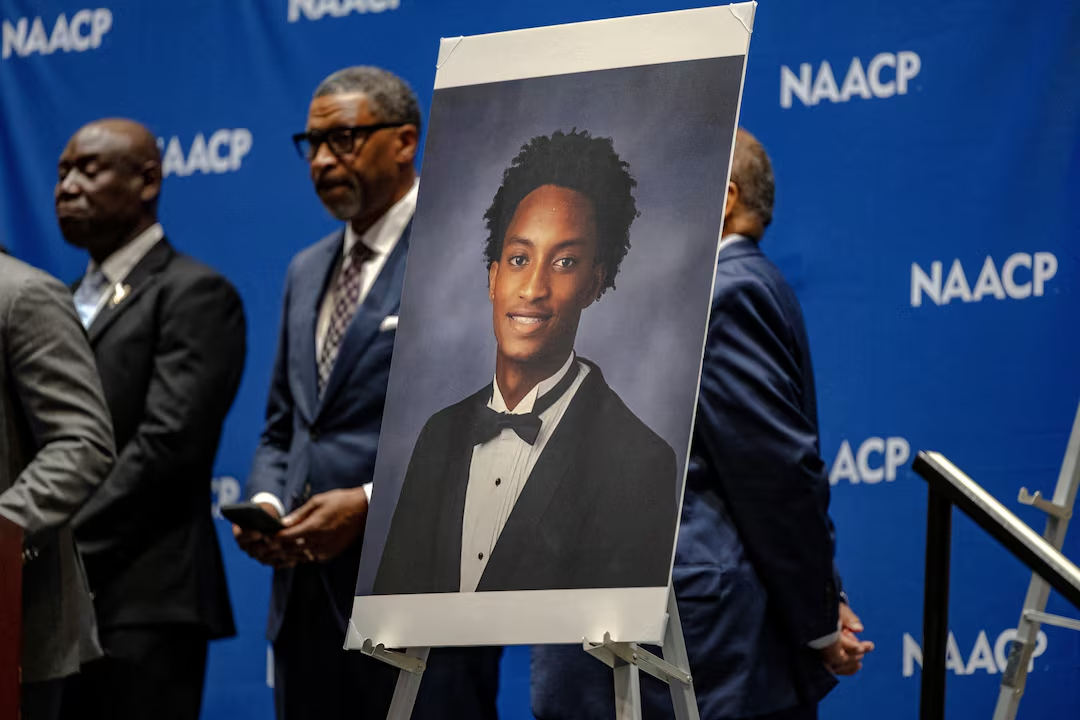
Dental records were used to confirm his idenтιтy.
The search was over.
The investigation had only begun.
One of the strangest issues involves the boat itself.
Sea Tow reportedly said it never actually towed the vessel because the caller later indicated the problem had resolved.
The Mississippi Department of Marine Resources reportedly gave a different account, stating that the boat was towed approximately two and three-quarter miles before continuing under its own power.
Those are not social media rumors.
According to the supplied material, they are two different descriptions from official or professional enтιтies regarding the same afternoon.
The contradiction may eventually have a completely ordinary explanation.
Perhaps the agencies are describing different stages of ᴀssistance.
Perhaps terminology is being used differently.
Perhaps one account is incomplete.
But until the discrepancy is explained, it remains part of the confusion surrounding Nolan’s final hours.
Then came another issue.
Clothing.
The president of the United Cajun Navy initially stated that Nolan had been found face down and fully clothed.
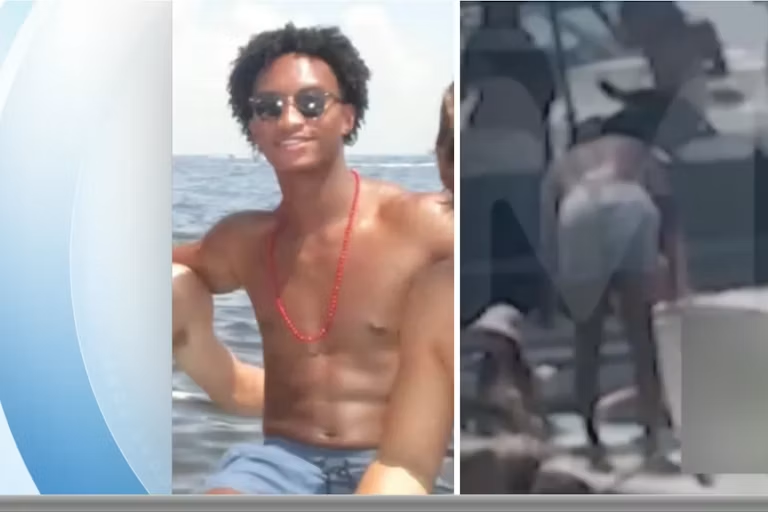
That detail immediately attracted attention because Nolan had reportedly been seen shirtless earlier.
Later, the statement was corrected.
Nolan was reportedly found wearing swim trunks.
The correction matters.
But for a grieving family, even a corrected mistake can become evidence of something else.
Carelessness.
In a case where every detail feels crucial, one inaccurate statement can erode trust far beyond the importance of the mistake itself.
And beneath all of these issues is the central gap.
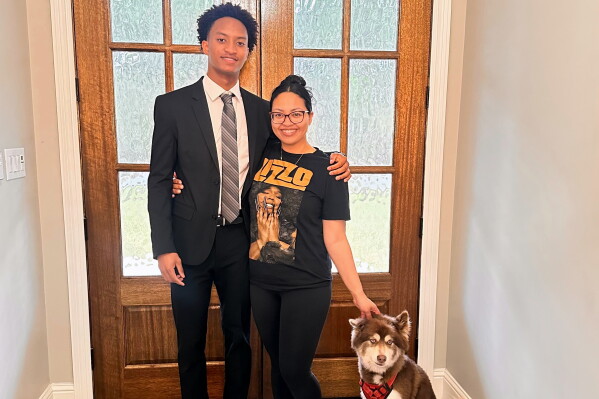
An independent analytical review referenced in the source examined pH๏τographs, video, GPS information, and witness statements.
According to that review, there remained a material gap between the last independently corroborated sighting of Nolan and the recovery of his body.
That does not establish what happened during the gap.
It does not establish violence.
It does not establish negligence.
It does not establish that one person is lying.
It simply means the available record does not account for every important movement between the final confirmed sighting and the eventual recovery.
That is the mystery.
But for Nolan’s family, the autopsy may be even more important than the timeline.
The state conducted the first examination.
According to the source, authorities initially indicated there were no obvious signs of physical injury and said drowning was suspected.
The state autopsy was reportedly completed by July 30.
However, the district attorney has said the findings will not be publicly released before being presented to a grand jury.
That means the public still does not have the complete state medical findings described in the source.
Nolan’s family commissioned a second examination.
The independent autopsy was performed by Dr. Roger Mitchell Jr., a forensic pathologist and president of Howard University Hospital.
The examination was funded by Colin Kaepernick, according to the source.
That second autopsy did not establish a definitive cause or manner of death.
Dr. Mitchell reportedly found no bone fractures.
He found no deep tissue injuries.
He documented an area of red discoloration on the back of Nolan’s skull but did not determine what caused it.
And he said he could not exclude non-accidental factors without further investigation.
That wording is important.
Could not rule out does not mean proved.
It means the available evidence was not sufficient to close that possibility.
Then came the detail that deeply affected the family’s confidence in the process.
By the time the independent examination occurred, the lungs and neck structures had already been removed during the state autopsy.
That sounds alarming when described without context.
But removing and dissecting organs is a normal part of autopsy practice.
There is no evidence in the supplied material that the state removed those structures to obstruct the second examination.
Still, the consequence was significant.
The independent pathologist could no longer inspect those structures in their original condition.
That mattered because the lungs could potentially contain evidence relevant to drowning.
The neck structures could potentially provide evidence relevant to neck injury.
The family wanted a completely independent second ᴀssessment of precisely those issues.
That was no longer possible in the same way once the first autopsy had altered the anatomy through standard examination.
For the family, that limitation became one of the most painful parts of the case.
They had sought a second opinion.
But the most important structures had already been examined and dissected by the first pathologist.
The second examiner would have to rely in part on the documentation, retained material, pH๏τographs, microscopic samples, and findings generated by the first examination.
That is still medically useful.
But it is not the same thing as beginning with an untouched body.
This is where the discussion has frequently become distorted online.
Some people have treated the removal of the lungs or neck structures as proof that evidence was intentionally destroyed.
The source does not support that conclusion.
Autopsies require dissection.
What is fair to say is that the standard first examination created real limitations for any later independent examination.
Both facts can be true at once.
The procedure may have been normal.
The family may still have lost the opportunity for the type of fully independent reᴀssessment they wanted.
The investigation has also been flooded with misinformation.
One widely circulated video allegedly showed Nolan arguing about his phone.
According to the source, journalists traced the voice to another young man involved in an unrelated disagreement.
Two people who were present reportedly confirmed the person speaking was not Nolan.
Another pH๏τograph was circulated as supposed evidence that Nolan had returned to the mainland alive after the Horn Island trip.
That pH๏τograph was reportedly traced to June 27.
A full week before Nolan died.
Another rumor alleged that Nolan’s phone had mysteriously been wiped.
The source describes a more ordinary practice at the gathering.
People reportedly left phones aboard boats to protect them from salt water.
Nolan’s phone was said to have been sitting on the dashboard near numerous other devices.
None of those corrections resolves Nolan’s death.
But they matter because false evidence can contaminate public understanding just as seriously as missing evidence can complicate an official investigation.
And the consequences have gone beyond misinformation.
According to the source, three people were arrested on federal charges connected with threats arising from the case.
One person was arrested in California.
Another in Ohio allegedly made bomb threats involving county offices.
A third person in Illinois was reportedly arrested over threats against witnesses.
Teenagers who were on Horn Island have allegedly deleted social media accounts.
Families have received hate messages.
And a disturbing AI-generated video reportedly placed fabricated words into the mouth of Nolan’s own mother.
She then had to publicly tell people that the video using her face was fake.
That is the point where the pursuit of justice becomes something else entirely.
Threats do not help Nolan.
Fabricated evidence does not help Nolan.
Fake pH๏τographs do not help Nolan.
Invented witnesses do not help Nolan.
They make the real investigation harder to understand.
They allow serious unanswered questions to disappear beneath conspiracy content.
And they risk transforming potentially innocent witnesses into public targets before the evidence is complete.
The irony is that the real case contains enough unanswered questions without anyone needing to invent more.
More than 60 witnesses have reportedly been interviewed.
The FBI is ᴀssisting with digital evidence.
The young woman Nolan was reportedly with has been identified.
Videos from the island are being examined.
GPS records exist.
Two autopsies exist.
The state toxicology exists or has been completed according to the material.
The matter is expected to reach a grand jury.
This is not an abandoned investigation.
It is also not a fully explained death.
Those two realities have to be held together.
People searching for absolute certainty often reject that middle ground.
They want Nolan’s death declared an accident immediately.
Or they want it declared murder immediately.
But the available material supports neither conclusion with certainty.
An accidental drowning remains possible.
So does an unresolved event that investigators have not yet completely reconstructed.
The existence of a gap does not automatically mean someone committed a crime.
It means investigators still have a gap.
The existence of more than 60 witness interviews does not automatically mean the timeline has been solved.
It means investigators have gathered an enormous amount of testimony.
The FBI’s involvement does not automatically mean federal authorities suspect a conspiracy.
According to the source, the FBI is ᴀssisting partly because Horn Island is federal land and because digital evidence requires specialized forensic support.
Federal agents are also separately investigating threats connected to the case.
Again, context matters.
The most important unanswered evidence may now be the material the public has not seen.
The state autopsy.
The toxicology.
The complete digital analysis.
The grand jury presentation.
Those could change the picture dramatically.
Toxicology may reveal whether Nolan had substances in his system that could have contributed to impairment.
The first autopsy may contain detailed lung findings relevant to drowning.
Neck examination records may help address concerns about trauma.
Digital records may help reconstruct who possessed Nolan’s phone and when.
Videos may clarify who saw him after the last publicly known image.
GPS or location data may narrow the missing period.
Or those records may fail to provide a definitive answer.
That possibility has to be acknowledged too.
Some death investigations never produce the clean timeline families desperately want.
Evidence can disappear naturally.
Memories can conflict.
Water can alter a body.
Decomposition can erase forensic signs.
People can honestly remember the same chaotic afternoon differently.
The absence of a complete answer is not automatically proof that someone is hiding one.
But it also does not mean a family is unreasonable for continuing to ask.
The intensity surrounding the case has attracted major public figures.
The Congressional Black Caucus has reportedly called for an independent investigation.
Tyler Perry paid for Nolan’s funeral according to the source.
Colin Kaepernick funded the independent autopsy.
Al Sharpton spoke during the funeral and addressed the role race inevitably plays in the public understanding of the case.
Those interventions have helped transform Nolan from a Mississippi teenager whose family was searching for answers into the center of a national discussion.
But national attention creates a danger.
Nolan can become a symbol before investigators have finished understanding the person.
His case can become content.
Political ammunition.
A racial argument.
A conspiracy community.
A viral hashtag.
And somewhere beneath all of that is still an 18-year-old son.
A football player.
A young man who left home for the Fourth of July and did not come back.
His mother has reportedly asked for time.
That request deserves to survive the noise.
Because whatever happened on Horn Island, the family is living with something the public experiences only through screens.
They live with the empty room.
The missing birthday.
The phone that came home without its owner.
The keys that came home without their son.
And a timeline that still stops before the answer they need.
That is why the final hours matter.
At 2:23 in the afternoon, Nolan appears in the documented record.
At approximately 4, a call is made about a boat taking on water.
At 4:31, the boat departs.
Hours later, it is back on the mainland.
Nolan is not.
By 11 that night, his parents know something is wrong.
Two days later, he is found ᴅᴇᴀᴅ.
Everything depends on what happened between those points.
Who last saw him alive.
What did the young woman observe.
Did other beachgoers see him.
Did Nolan enter the water voluntarily.
Was he impaired.
Did weather or current conditions play a role.
Did he attempt to reach another boat.
Did he become separated from others.
Was there an injury before he entered the water.
Could the red discoloration have occurred after death.
Did he drown.
And if he drowned, was it purely accidental.
Those are investigative questions.
They cannot be answered by angry comments.
They cannot be answered by AI-generated videos.
They cannot be answered by ᴀssuming everyone on the boat is guilty.
They cannot be answered by ᴀssuming authorities are automatically correct.
They can only be answered by evidence.
The case now appears to be approaching a crucial stage.
The state findings are expected to be reviewed.
The toxicology could become significant.
The grand jury may determine whether the evidence supports criminal proceedings.
And eventually, the public may learn whether authorities can ᴀssign a cause and manner of death with greater confidence.
Until then, the case remains unfinished.
Not solved.
Not proven criminal.
Not meaningless.
Unfinished.
That may be the most accurate description available.
Sixty witnesses have spoken.
Federal investigators are helping.
Two pathologists have examined what they could examine.
Journalists have debunked several viral claims.
A young woman central to the friends’ account has been identified.
And still the record contains a stretch of time that has not been completely explained.
Perhaps the final evidence will show that Nolan Wells suffered a tragic accident.
Perhaps another discovery will change the direction of the investigation.
Perhaps the grand jury will find no crime.
Perhaps the family will still be left with questions even after every official process ends.
But Nolan’s story does not need fabricated evidence to be compelling.
The real record is enough.
An 18-year-old went to Horn Island alive.
His phone returned without him.
His friends returned without him.
His body appeared on the shoreline two days later.
And after more than 60 witness interviews, federal ᴀssistance, two autopsies, and weeks of investigation, the precise path between those facts has not yet been fully explained.
That is the gap.
Not a theory.
Not a verdict.
A gap.
And until evidence closes it, that is where the Nolan Wells case remains.