
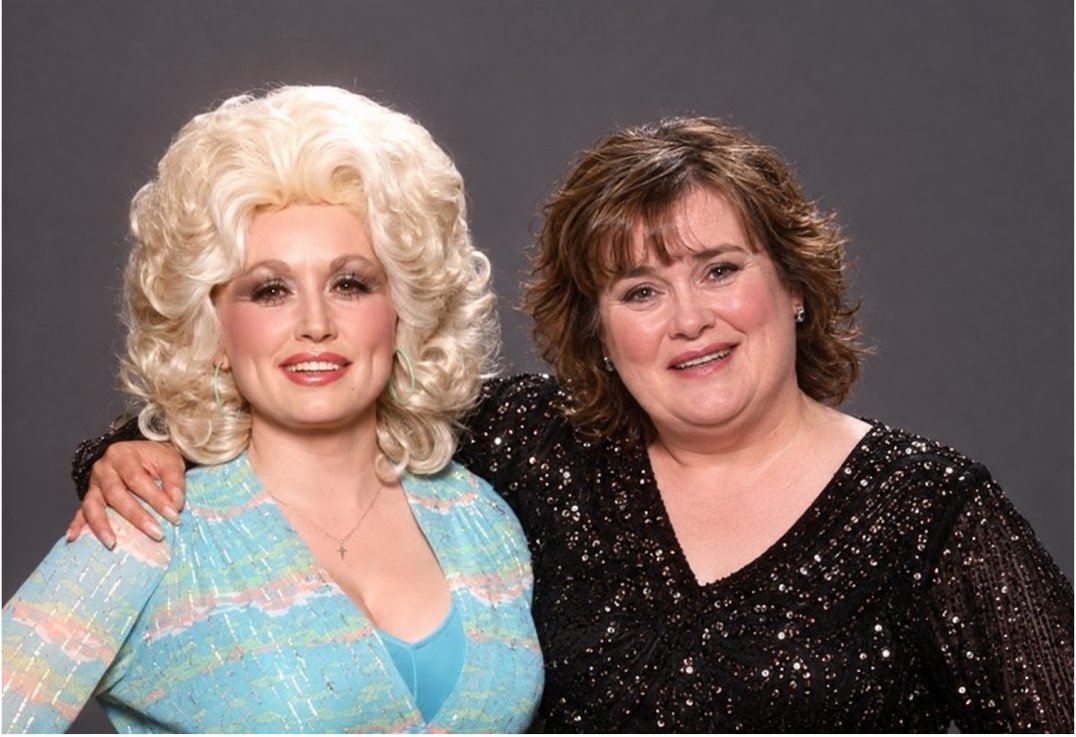
Dolly wrote songs that sounded deeply personal even when millions of people were singing them.
Susan sang songs written by others and somehow made listeners feel as though she had lived every word.
That emotional connection is perhaps why the idea of Boyle paying tribute to Dolly feels so powerful.
It is not simply one famous singer honoring another.
It is one unmistakable voice recognizing the humanity behind another.
Throughout her career, Dolly Parton has been praised for achievements that would be almost impossible to summarize.
She wrote enduring songs including “Jolene,” “Coat of Many Colors,” and “I Will Always Love You.”
She crossed from country music into mainstream pop without abandoning the storytelling traditions that shaped her.
She became an actress, businesswoman, author, theme-park founder, and philanthropist.
Through her Imagination Library, millions of books have been given to children, extending her influence far beyond the recording studio.
Yet those accomplishments alone do not explain why people feel such affection toward her.
Awards can prove success.
Sales can prove popularity.
But neither can explain love.
That came from somewhere else.
It came from the feeling that Dolly understood ordinary people because she never forgot where she came from.
Born into a large family in rural Tennessee, she grew up with very little money.
Those childhood experiences later became central to her music and public idenтιтy.
She never treated that past as something to hide.
She turned it into strength.
Susan Boyle’s story carries a similar emotional theme.
Before the television performance that changed her life, she lived quietly in Scotland, singing in local venues and caring for her mother.
When global fame arrived, audiences did not simply respond to her voice.
They responded to her journey.
She reminded people that talent does not always arrive packaged the way the entertainment industry expects.
Dolly spent much of her own career delivering a similar message.
Never mistake appearance for substance.
Never allow someone else’s expectations to define your value.
Never be ashamed of where you started.
In the imagined tribute, Susan becomes emotional when discussing exactly that idea.
“She made people feel seen,” she says. “That is such a rare gift.”
The words hang in the air.
For a moment, there is silence.
Then Susan continues.
She remembers not the stages or trophies, but the humor. The kindness.
The ability Dolly had to make someone feel important even when dozens of people were competing for her attention.
Those small qualities become the heart of the tribute.
Because when someone becomes an icon, the public tends to remember the biggest moments.
The number-one records.
The television appearances.
The famous pH๏τographs.
But friends and admirers often remember something completely different.
A joke.
A private conversation.
A look across a crowded room.
A laugh.
That is why those two words — “her laugh” — become the emotional center of this imagined story.
They strip away everything surrounding Dolly Parton’s fame and leave only the human being underneath.
And perhaps that is the most meaningful tribute anyone could offer.
Legends are remembered for what they achieve.
People are remembered for how they make others feel.
For generations of listeners, Dolly’s songs provided comfort during heartbreak, courage during uncertainty, and joy during ordinary days.
For artists such as Susan Boyle, she represented proof that personality, generosity, and sincerity could survive even at the highest levels of fame.
Toward the end of the imagined conversation, Boyle is asked what she believes Dolly’s greatest legacy would be.
This time, she does not hesitate.
“The way she made people feel loved.”
It is another simple answer.
And once again, it says almost everything.
Music eventually stops playing.
Spotlights eventually go dark.
Awards gather dust.
But kindness has a strange way of continuing long after the moment in which it was given.
That is the Dolly Parton Susan Boyle chooses to remember in this fictional tribute — not merely the superstar whose songs traveled around the world, but the woman whose warmth stayed with the people who encountered her.
And when Susan finally falls silent, there is no dramatic conclusion.
There does not need to be.
Sometimes the most powerful goodbye is not a speech at all.
Sometimes it is simply remembering a laugh.